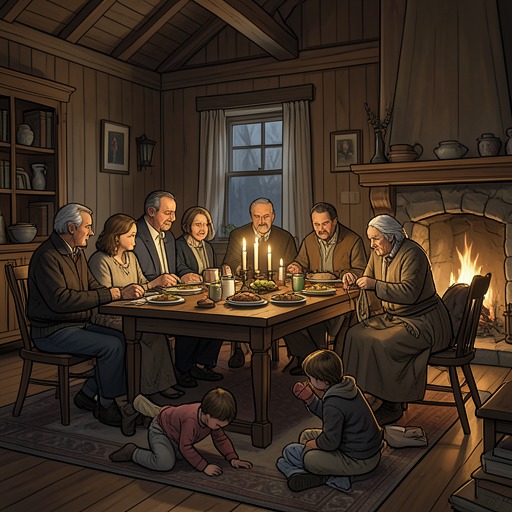
Count Ilya Rostov
War and PeaceCount Ilya Rostov is the warm-hearted patriarch of the Rostov family, a man whose hospitality and spontaneous generosity make his household a place of abundance even as they undermine its finances. He welcomes everyone with the same open manner, spends freely on family and guests, and finally orders his valuable carts to carry wounded soldiers out of Moscow rather than preserve his possessions. His goodness is therefore both his family’s emotional inheritance and the source of its material ruin.
Identity and Household Position
Count Ilya Rostov presides over a large Moscow household whose public life is organized around hospitality. On the name day of Countess Natalya Rostova and Natasha Rostova, carriages arrive continually at the family’s house on Povarskaya Street, and the count personally receives the visitors. He is presented as an older, full-faced, cheerful man whose bald head, scanty gray hair, repeated bows, and firm handshakes form part of his recognizable social performance. His manner is not reserved or selective: he addresses everyone as “my dear,” whether the visitor is above or below him in rank, and invites each person to dinner with the same warmth.
His welcome is active rather than ceremonial. After seeing one guest out, he returns to those still in the drawing room, draws a chair toward them, spreads his legs, places his hands on his knees, and offers opinions about the weather or health in Russian and in self-confident but poor French. He repeatedly rises to fulfill the duty of seeing people off, then resumes the same cheerful conversation. The scene makes his hospitality seem almost inexhaustible, while also suggesting that it is a habit so deeply embodied that he cannot easily separate generosity from the conduct of everyday life.
Count Ilya Rostov’s household also contains a contrast in social temperament. When Vera Rostova makes a correct and appropriate remark, the visitors and the countess alike respond with awkwardness, as though her explicit intelligence violates the family’s more instinctive emotional code. The count jokes that the countess had been too clever with Vera, then assures her that she has nevertheless turned out splendidly. His response is affectionate and socially smoothing: he absorbs discomfort through humor rather than analysis, preserving the household’s atmosphere of ease.
Hospitality and Extravagance
The count’s generosity extends beyond conversation into costly public display. He has belonged to the Moscow English Club from the day it was founded and serves on its committee. When the club prepares a dinner in honor of Prince Pyotr Bagration, he takes personal charge of the arrangements, ordering asparagus, fresh cucumbers, strawberries, veal, fish, elaborate cold dishes, large sterlets, turtle soup with cocks’ comb, and additional entrees. The meal is expected to cost several thousand rubles, yet Count Ilya Rostov is willing and able to make up from his own resources whatever is needed for its success.
This extravagance benefits others as well as himself. The cook and steward listen with satisfaction because they know that a dinner under his management will allow them to extract a good profit. The count’s open-handedness thus creates a whole economy of social pleasure, employment, and opportunism. He is not portrayed as a calculating patron who measures return on expenditure; he spends because abundance seems to him the natural form of generosity and because a successful feast confirms the social world he loves.
That same pattern governs the family’s finances. During the two years at Otradnoe, the Rostovs’ debts continue to increase, with Mitenka’s management of affairs specifically identified as part of the problem. Count Ilya Rostov eventually goes to Saint Petersburg to seek an official post, while presenting the journey as an opportunity to let the young women enjoy themselves for the last time. The contrast is characteristic: financial necessity is real, but it remains interwoven with his impulse to preserve pleasure, sociability, and family life.
The Moscow Evacuation
Count Ilya Rostov’s decisive moral action occurs during the evacuation of Moscow. Thirty peasant carts have arrived from the family estates, and their value has become extremely high because wounded officers and soldiers urgently need transport. The major-domo initially refuses their requests, reasoning that one cart could not be granted without creating an obligation to grant all of them, and that the family could not save everyone while ignoring its own needs.
The count enters the yard in a lilac silk dressing gown, softly leaving his bedroom so as not to wake Countess Natalya Rostova, who had only fallen asleep toward morning. When he sees an elderly orderly and a pale young officer with a bandaged arm, he asks whether they are staying in his house. The officer begs for a place in one of the carts, saying that he could manage even on a loaded cart; the orderly makes the same appeal for his master. Count Ilya Rostov immediately agrees and tells the major-domo to unload one or two carts.
The gesture becomes a command with consequences larger than the count initially articulates. Seeing wounded men gathered at the gates, windows, and wings of the house, he orders that no wounded person asking for a lift is to be refused. He enters the house repeating that instruction, adding softly that some possessions can be unloaded. His hesitation concerns property, but his decision is already settled by the gratitude visible on the officer’s face and by the sight of the wounded waiting for help.
Natasha Rostova then confronts the family’s attachment to its luggage. She protests that leaving the wounded is impossible and monstrous, while Countess Natalya Rostova, ashamed and disconcerted, finally tells her husband to order what is right. Count Ilya Rostov responds through tears of joy, saying that “the eggs... the eggs are teaching the hen,” as the younger generation teaches the older what must be done. Natasha takes charge of the work, and the count confirms the order to give every cart to the wounded and move the trunks into storage. The servants, who shortly before had considered abandoning the wounded normal and carrying away the goods necessary, begin eagerly placing the injured in the carts. His compassion changes not only the family’s decision but the entire household’s perception of what is possible and right.
Decline, Death, and Legacy
The evacuation has a material cost that the count accepts without turning it into a heroic calculation. His household gives up the means of transporting its possessions at the moment when those possessions are most valuable. The action crystallizes his character: he does not solve the catastrophe, and he cannot save every wounded person, but he refuses to convert scarcity into an excuse for protecting his own wealth. His generosity is immediate, embodied, and contagious.
After the burning of Moscow, the flight from the city, the death of Prince Andrei Bolkonsky, Natasha’s despair, and Petya Rostov’s death, the accumulated blows fall upon Count Ilya Rostov. He becomes frightened and distraught at times, and at other times unnaturally animated and enterprising. He arranges dinners and suppers connected with Natasha Rostova’s marriage and tries to appear cheerful, but his cheerfulness no longer spreads pleasure; instead, it arouses compassion in those who know him. After Pierre Bezukhov and his wife leave, the count grows quiet, complains of depression, and soon takes to his bed.
He understands from the beginning that he will not recover, despite the doctor’s encouragement. Countess Natalya Rostova spends a fortnight beside his pillow without undressing, and whenever she gives him medicine he sobs and silently kisses her hand. On his final day, after asking his wife and his absent son to forgive him, he identifies his principal fault as having dissipated the family property. The confession is economically precise but emotionally revealing: even at death, he understands his life through responsibility toward the family he has sustained and endangered.
He receives communion and unction and dies quietly in 1813, the same year as Natasha Rostova’s wedding to Pierre Bezukhov, described as the last happy event in the old Rostov family. His death follows the collapse of the household’s former world. The family group breaks apart, and the financial consequences become unmistakable after his funeral. When Nikolai Rostov hears of his father’s death while serving with the Russian army in Paris, he resigns his commission and returns to Moscow. A month later, the debts are revealed to be double the value of the property. Nikolai refuses to decline the inheritance because he regards such a refusal as a slur on his father’s sacred memory, accepting both the estate and the obligation to pay its debts.
Narrative Significance
Count Ilya Rostov embodies the novel’s tension between moral abundance and material limitation. His hospitality makes him vulnerable to flatterers, waste, and debt, yet the same incapacity for narrow self-protection produces his most admirable act. In the evacuation of Moscow, the family’s possessions become negotiable objects, while wounded human beings become the urgent measure of value; the count’s decision reverses the household’s practical logic and allows compassion to reorganize its labor.
His influence is therefore neither the power of Prince Vasili Kuragin, who treats social connections as capital, nor the administrative authority sought by the financially pressed Rostovs in Saint Petersburg. Count Ilya Rostov possesses a different kind of social force: the power of welcome, confidence, and uncalculated giving. It cannot preserve his estate. It does, however, preserve the moral meaning of his family at the moment when war, death, and debt are dismantling it. His legacy passes to Nikolai Rostov as a burden of repayment and to the household as a remembered standard of generosity, with the costly contradiction intact: the man who dissipated the family’s property is also the man whose goodness made that property secondary to human need.